|
Digital Photography and Orbs!!
Vince Wilson Founder of the Maryland Paranormal Investigators Coalition has this to say about Orbs and digital photography from his book "Ghost Tech". The NJGHS thanks Vince for this valuable information.
Please note: Used by permission by Vince Wilson and Ghost Tech, LLC. Do not copy or reproduce without authorization from Vince Wilson and Ghost Tech, LLC. Copyrighted material
You can learn from him directly at the NJ Ghost Conference 2006 this April 22!
From Canon's website:
"When shooting with flash in a location where there are many suspended particles, such as in a dusty area or on a snowy day, the image may contain white circles as shown in the picture below.
"Why does this happen?
"If the flash fires when a suspended particle floats right in front of the lens, the reflection of the flash from the particle appears more intensely than that of the subject, as the particle is much closer to the lens than the subject. "Therefore, the reflection of the flash turns out in the image
and causes an effect such as that shown in the sample image above. "The closer the lens and strobe are located, allowing suspended particles to be exposed to more light, the more frequently this effect can occur.
"How can I avoid this effect?
"Ideally, it is best to shoot in locations where there are very few suspended particles. If not, you can use following method to prevent this effect.
1. "Avoid using flash by lighting the area as much as possible.
2. "If your camera has a zoom function, shoot at a wide angle. "If you can attach an external flash, use the external flash to distance the flash from the lens."
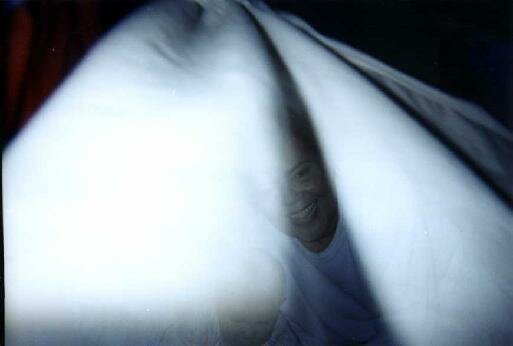
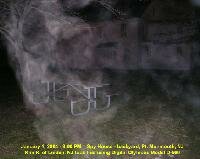
Most orbs are in fact particles (dust, water, dirt, etc.) in the air that are too close to the lens. The problem is that modern cameras are TOO SMALL. The flash illuminates particles in front of the lens. What you think is a six foot paranormal orb floating next to an investigator is actually a near microscopic particle about a 1/4" in front of the lens. This afflicts film as well as digital. SLR film cameras or cameras with the flash at least three inches from the lens are best used. I
Pixel Problems.
You're a budget conscience paranormal investigator who doesn't have a lot of money to through around. You just read that there's a new ion counter on the market and you cannot wait to get it. However, if you keep buying film the way you have, you will never be able to afford it. Thank
goodness for that digital camera you just bought. But, there's this little nagging
feeling in the back of your brain that keeps bothering you. When you listen to it you
begin to wonder, "How accurate are these things? Why do some paranormal investigators say I shouldn't use them?"
If you have read the second edition of Troy Taylor's Ghost Hunter's Guidebook you might recall him mentioning that CCD (Charge Coupled Device) digital cameras are sensitive to temperature variations in the environment. In low light situations the CCD will sometimes create faint patterns that
resemble circles or "orbs". According to the Nikon website (www.nikontech.com):
"Occasionally images from digital cameras will have "defect" pixels. These pixels may appear in the final photograph as bright white, green or red spots that are out of place when compared to the rest of the image. Sometimes people call these spots "hot" or "dead" pixels. "Usually these pixels, and other types of "digital noise" appear in the darker or underexposed parts of images; additionally, images taken at longer exposure times are much more likely to have this issue.
"Many Nikon cameras have a "noise reduction" or "NR" process that fixes these problem areas. When NR is activated and image exposure times drop below 1/4 of a second the NR automatically processes the images as they are saved. This Noise Reduction feature is sometimes called "Night
Portrait" or "Night Landscape" Scene Modes. "If these spots are seen on images photographed under normal conditions (bright light with exposure times shorter than 1/4 second) then
the camera may need to be sent in to a Nikon Service Center for repair."
That's not the only thing that will create false positive orbs. The same site goes onto say:
"As is common in many compact digital cameras where the built-in flash is very close to the lens strange reflections can appear in images under certain conditions. "Particulate matter in the air in front of the lens (between the camera and subject) such as water vapor (as in a cloudy day), smoke, dust or other items can reflect light directly into the lens causing neutral colored white/gray semi-transparent spots to appear in the image. "In extreme examples there may be many of these spots in an image or there may be only one per image. Also, since these spots are completely random
they will move or disappear from image to image. For example, if two images are shot consecutively with the same camera settings one image may have spots while the other is clean.
"To avoid these spots:
· "When possible, avoid photographing in smoky, dust, or cloudy areas
· "Do not use the camera's flash in locations such as above
· "Use an external Speed light flash if a flash is needed
· "Review images on the camera and re-shoot if spots are visible
· "Cleaning the lens will not have an effect on these spots, as the particles that cause this are not on the lens itself."
Just to put more emphasis on this, Canon's website
(www.canon.com) says:
"When shooting with flash in a location where there are many suspended
particles, such as in a dusty area or on a snowy day, the image may contain
white circles as shown in the picture below. "Why does this happen? "If the flash fires when a suspended particle floats right in front of the lens, the reflection of the flash from the particle appears more intensely than that of the subject, as the particle is much closer to the lens than
the subject. "Therefore, the reflection of the flash turns out in the image and causes an effect such as that shown in the sample image above. "The closer the lens and strobe are located, allowing suspended particles to be exposed to more light, the more frequently this effect can occur.
"How can I avoid this effect?
"Ideally, it is best to shoot in locations where there are very few suspended particles. If not, you can use following method to prevent this effect.
1. "Avoid using flash by lighting the area as much as possible.
2. "If your camera has a zoom function, shoot at a wide angle.
3. "If you can attach an external flash, use the external flash to distance the flash from the lens."
Orbs are the bane of serious paranormal researchers. When the press does a story on a group of ghost hunters who claim to have taken pictures of orbs, you always detect that faint bit of superiority in their voices when they mention "orbs". Now, I have little doubt that there are in fact ghostly
luminescent balls that are definitely paranormal "orbs", but I cannot promote digital cameras as a viable means of detecting them. It's not a coincidence that the "orb phenomenon" boomed after digital photography became popular. People didn't have to wait investigation after investigation
to get orb shots. They could get them in there own basement the day they buy the camera!
So, you get an external flash or use the camera without the flash. Solved these issues right? Nope. Digital cameras have a few other problems as well. Did you know that without filters a digital camera couldn't even see color? In a film camera what you see is what you get. However the photoreceptors in digital cameras cannot see color. They rely on filters to record each primary color (red, blue and yellow) separately and them combine them into a full color picture. As a matter of fact, most digital cameras can only approximate the closest colors to what is in the picture. The most expensive
models use separate filters to capture color. However, this is pricey and increases the size of the camera. Most SLR digital cameras are such. Lower cost models use interpolation to approximate the closest colors. Interpolation is a method used to increase the resolution of an image by adding pixels to an image based on the value of surrounding pixels. Although it looks "good enough" to the naked eye, you are looking at images with only guesswork determining the outcome of a picture. This method can also cause artifacts to appear. Ouch! Remember, us scientifically minded paranormal
investigators no like inaccuracies!
Another problem with digital cameras is compression. Lets say during your investigation you come across a room that has a lot of yellow in it. The walls and floor are yellow. You take out your three mega-pixel camera and take a few shots for later. Well, a multi-pixel digital camera needs a lot
of space on your memory card in order take nice pictures. One way of saving space is to leave out a little information. Do you really need every shade of yellow with every detail of that yellow present? Your eyes cannot see that much detail anyway. So, digital cameras just cut some details out that
you wouldn't be able to see anyway. This can add up to 50% or more of the original details of the picture being thrown out! Who knew?
We don't really know how ghosts appear in pictures. What we do know is that the most famous and generally considered authentic spirit photographs were taken with film. What's the most famous digital spirit picture n the world? I don't know either. So, is there a place for digital cameras in
serious paranormal investigating? Yes.
How to use Digital Cameras in a paranormal investigation
Digital cameras can be great back-up cameras and catalogers. An investigator can take a picture of a room and use the LCD viewer to see if there is any anomalous activity present. If there is you can take some pictures with a film camera. Keep in mind though you have to consider the possibility that the digital camera may have taken a picture of a false positive.
Check for dust or low light if you get a lot of orbs.
You can use your digi-cam to catalog the location as well. Take as many pictures as you want and upload them to a laptop. Take multiple angle views of each and every "hot spot" and at least one picture of every other room. Also, make sure to take some pictures outside the location. You'd want a picture of every angle of the outside of the site. This should definitely include some pictures of the front of the location and all the building's windows. You can use these pictures to plan your initial
investigation. Digital cameras are definitely cool ghost tech when used properly.
|